
This article is part of a series of posts that act as an alternate version of a scouting report. If you are interested in learning the answers to the most simple prospect questions, feel free to check out this and more at the Prospect Snapshot homepage.
Who is he?
DJ Artis was drafted by the Cubs in the 7th round of the 2018 draft out of Liberty University and signed for $250K. He is a 23-year-old, left-handed hitting outfielder listed at 5-9 and 165 pounds but he shared with the Growing Cubs Podcast that he is actually closer to 5-11 and 195 pounds. Artis has put together just one full season as a professional, suiting up for Low-A South Bend and High-A Myrtle Beach in 2019 while spending a couple weeks in the Arizona Rookie League rehabbing an injury.
Artis is the most decorated player in Liberty baseball history and entered his final year with the Flames as a hopeful first round pick. He has the skillset of a future leadoff man, but will be taking a huge step in 2021 if he begins the year in Double-A after spending very little time in the lower-levels of the minors.
What do the numbers look like?
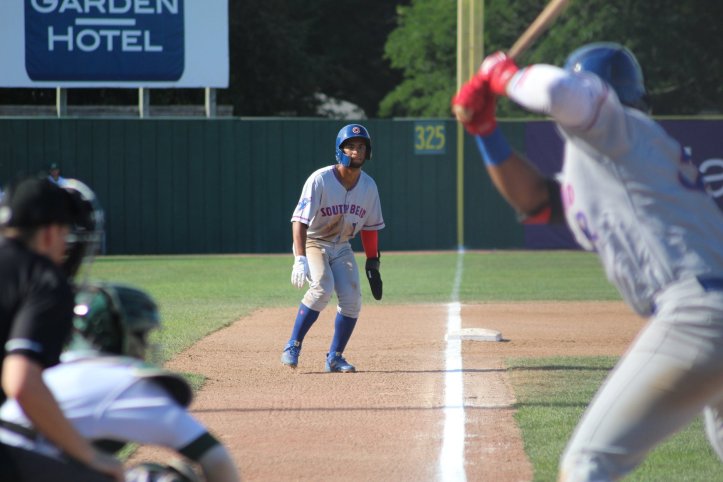
The biggest chunk of 2019 was spent in Low-A South Bend for Artis where he hit a decent .267 with an incredible .390 OBP thanks to his outrageous 13.5% walk rate. The power lagged behind, hitting his only two bombs on the year in the Midwest League on his way to a season-long .341 slugging percentage.
The statistic that really stands out to me with Artis is his average flyball distance (275 feet) and his ground ball percentage (51.2%). Both of those numbers find themselves on the wrong side of the spectrum. Even though a speedster like Artis will thrive off hitting more ground balls than most hitters, he will need to lower than number a bit to improve his slugging using balls in the air and liners in the gap. However, that work will be a moot point if he isn’t able to hit the ball further in the air.
What makes him good?
For one, Artis has speed to burn. That is a skill that has been absent from the legit prospects in this system for quite some time. He has the speed and instincts to steal 20 bases year-in and year-out. I’ll admit that I haven’t gotten enough of a look at him defensively, mostly due to his limited action in 2019. With his plus speed there is no reason why he shouldn’t stick around in centerfield.
Artis’s on-base skills are his carrying trait at the plate, as he has the ability to draw more walks than anyone I’ve seen in the system recently not named Mark Zagunis. He credits his dad as the reason why he has such a great eye, but not in the way you would think. He says his father was so bad at throwing batting practice that he grew accustomed to taking pitches. That skill is what makes him more of a top-of-the-order bat, even more so than his speed.
What needs some work?
There are three issues with DJ’s game as it stands going into the 2021 season: his throwing arm, strikeout numbers, and power. The bright side is that Artis himself directly and indirectly addressed those gaps in his interview on Growing Cubs.
He said that his arm strength is something he has been consistently working on during the long offseason. That will even further allow for him to stick in center where his bat profiles better than in left field.
In the podcast and in a piece I wrote for Cubs Insider, he also mentioned that he wants to work on pulling the ball in the air more. That is obviously where his power is going to come from, as guys with his stature aren’t often going yard to the opposite field. But where I think that approach can actually help in his development is by cutting down on his strikeouts. Bear with me on this one…
Jumping on pitches to the pull-side is going to come from hunting his pitch (often fastballs) early in the count. What that means is you may see Artis in fewer two-strike counts where he is forced to deploy a defensive swing. Opting for an A-swing over a defensive swing means more slugging. Hitting pitches early in the count means a higher batting average. And most importantly, fewer two-strike counts means less opportunity for strikeouts. His swinging strike rate was only 9.5% and is not the problem. The unfavorable counts he often finds himself in are, but that can be fixed.
When could we see him in Chicago?
So much surrounding DJ’s development in Double-A Tennessee will tell us where and when we expect to see him in Chicago. If the power numbers can turn into “better than Albert Almora” levels and the arm strength is legit, then he could be a starting caliber centerfielder in Chicago. That path has a late-2023 to early-2024 timeline.
If the slugging isn’t good enough to be an MLB regular, then he could profile well as a 4th outfielder. That could actually accelerate his timeline to late-2022 or early-2023 because he won’t necessarily need consistent, everyday at-bats.
If neither of those skills develop in ways I believe they can, then we are looking at a Zagunis type of career, just replacing Marky Z’s power with Artis’s speed. I’m betting on scenario #2 and hopeful for scenario #1.
 Out of the Vines