
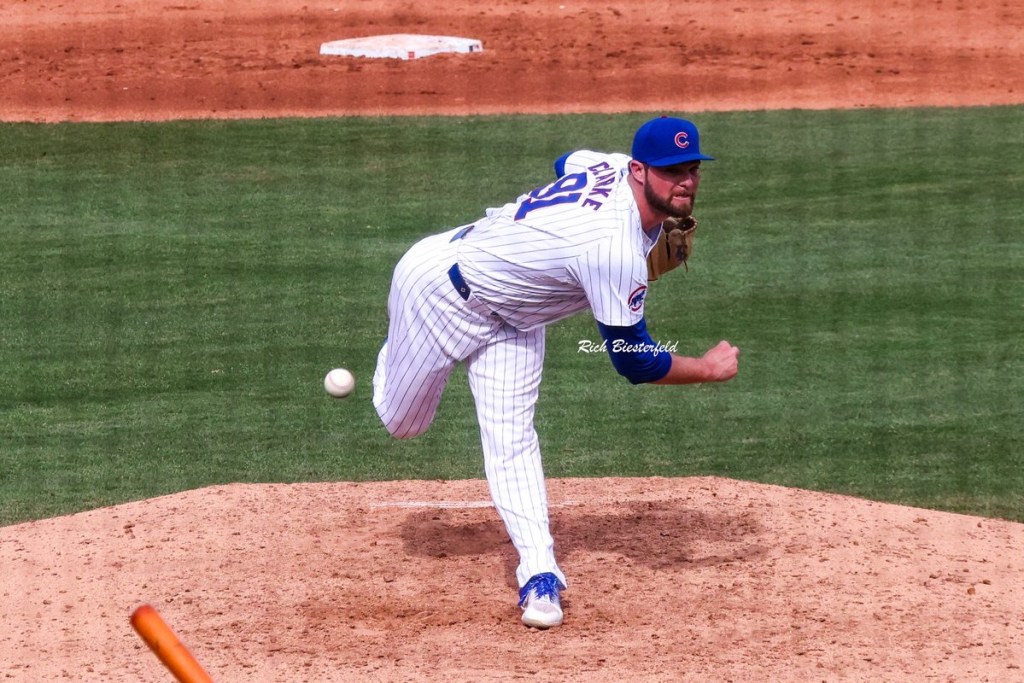
By midsummer in Myrtle Beach, the Pelicans’ season had begun to feel like a grind. The roster was young, raw, and learning the rhythms of professional baseball. Losses piled up, frustrations simmered, and the team seemed stuck in neutral.
Then Chris Clarke walked into the clubhouse.
Clarke wasn’t a Top 100 prospect or a headline-grabbing call-up. He was a 27-year-old right-hander with six minor league seasons under his belt and significant innings in Triple-A, sent to Myrtle Beach, the lowest level of the full-season affiliates, as a rehab stop for one week on his way back from injury. But what happened next became the defining story of the Pelicans’ season. So much so that people around the team began referring to the season timeline in two parts: Pre-Chris Clarke and Post-Chris Clarke.
Clarke didn’t arrive with a speech or a plan. He arrived with presence. And he did so on a team filled with guys who didn’t know him personally, if at all.
“I was a veteran, so I walked into the clubhouse and I knew there were eyes on me,” Clarke said on the Cubs On Deck podcast. “But I didn’t realize how many questions were going to be asked. And I didn’t realize how many good questions were going to be asked by such young players.”
The questions came fast: about routines, about pitch sequencing, about handling failure. Clarke answered them all. He wasn’t lecturing, instead simply responding to inquisitive youngsters. “I just gave them an honest answer,” he said. “And when something stood out, I would just pull a couple of guys aside and say, hey, this is why we do this and this is why we don’t do this.”
One of those moments came with Ty Southisene, the 19-year-old former 4th round pick. In a bases-loaded situation on June 11th, the day Clarke made his first start for the Pelicans, Southisene struck out and let his frustration spill out. Clarke waited a couple of days before pulling him aside.
“I pointed out to him that when you show negative emotion as a player, it’s a sign of weakness,” Clarke recalled. “All you’re doing is fueling the pitcher because he’s going to start thinking ‘Oh, I got these guys, they’re on the ropes.’
“So I spoke to him about how body emotion can kill you in any situation in baseball, even if you are the best player… You have to show up and be as confident as possible — even if it’s fake. Because if you show any sign of weakness, the opponent knows they can take advantage of you.”
For Southisene and others, it reframed how they carried themselves in the game’s most pressure-packed moments.
Clarke insists the transformation wasn’t about him. It was about the players’ willingness to learn.
“The only reason why those guys learned so much the time that I was there is because of the questions that they asked,” he said. “They took advantage of the pick-the-brain strategy when you have a vet around. I just gave my best answer and they took it and ran with it. So it wasn’t me.”
But teammates saw it differently. Clarke’s presence gave them permission to ask, to absorb, to grow. His answers carried weight because they came from someone who had lived the grind and was a player just like them.
“That was such a blessing having a veteran show me how to be a professional,” said Jackson Kirkpatrick, a reliever playing his first season of pro ball. “It would’ve been easy for him to isolate himself, but instead he was happy to help guys. Chris is a really positive guy and I think that rubbed off on us.”
Before his final day with Myrtle Beach, Clarke gathered the team together. His message was simple, but it stuck.
“If there’s a moment where you feel like your back’s up against the wall, or you feel like you’re getting pressed, or there’s the bases loaded with nobody out, or you’re pitching and you just threw six balls in a row — If you don’t believe something can happen, it will never happen. You have to will it into reality.”
That speech was all the young Pelicans’ needed to hear. Players began to frame every challenge as an opportunity to grow stronger. The day Clarke arrived in the Pelican clubhouse, the team was 20-35. From that point forward, they posted an absurd record of 48-25 and took home the Carolina League South Division title in the second half of the season.
Not only did that turning point reveal itself in the team’s record, but in the individual stat sheets as well, especially for a quintet of hitters playing their first seasons in full-season ball.
Southisene
Pre-Clarke: 83 wRC+
Post-Clarke: 126 wRC+
Alexey Lumpuy
Pre-Clarke: 55 wRC+
Post-Clarke: 125 wRC+
Yahil Melendez
Pre-Clarke: 86 wRC+
Post-Clarke: 123 wRC+
Angel Cepeda
Pre-Clarke: 104 wRC+
Post-Clarke: 125 wRC+
Matt Halbach
Pre-Clarke: 110 wRC+
Post-Clarke: 124 wRC+
“They really took it to the next level,” Clarke said. “Because then every single time their back was up against the wall, they knew as a collective unit, all they had to do was just believe what was supposed to happen would happen.”
Clarke may downplay his role, but the evidence was undeniable. His lessons on composure, confidence, and belief didn’t just change games — they changed the culture.
For Myrtle Beach, the season wasn’t just about wins and losses. It was about young prospects learning how to carry themselves as professionals. And in that transformation, Chris Clarke’s fingerprints were everywhere.
 Out of the Vines
Greg, what a great story. How 1 guy can change the whole culture of the team and DID! Stories like this are inspiring. Thanks for putting this together. I look forward to more like this.
hrm3rd
LikeLike
I’m really glad you liked it! Chris and his story definitely inspired me and I’m just glad I could tell it in this form!
LikeLike
[…] good stuff to read about the system. However, Greg Huss, my former partner at North Side Bound, interviewed former prospect Chris Clarke about his one week at Myrtle Beach and how that turned this season around for the Pelicans. It’s […]
LikeLike