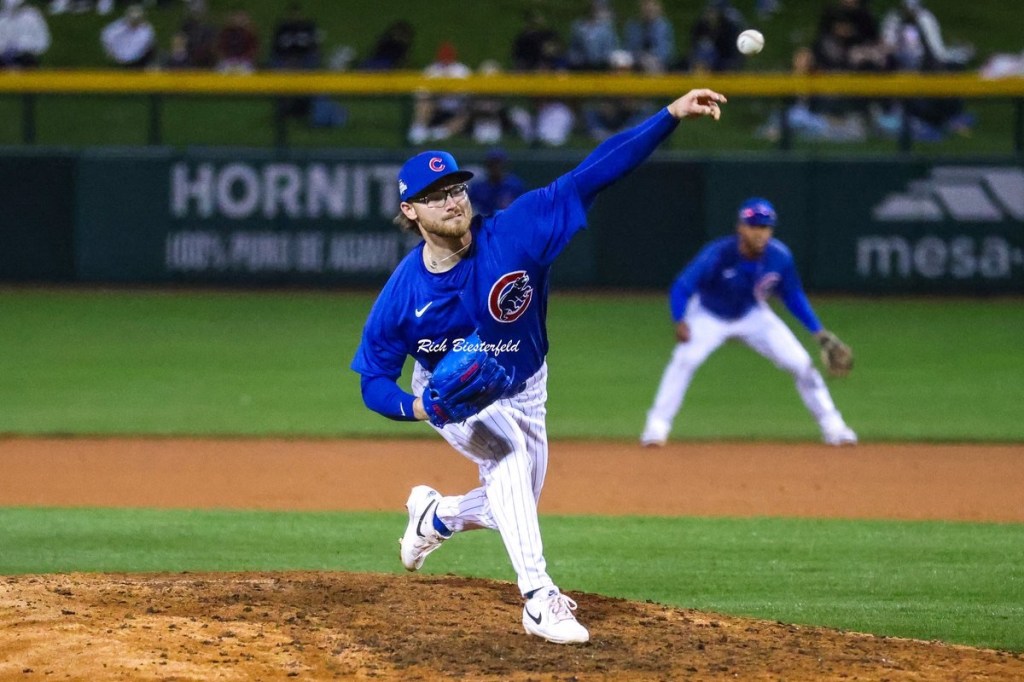
When Riley Martin takes the mound for his Major League debut, it will mark the culmination of years of deliberate work in places that don’t typically get the spotlight. His journey didn’t follow the traditional blueprint, and the idea of pitching in a big league stadium wasn’t always on his radar. Not realistically. Not for a Division II arm from Quincy University. Not for a guy who once sat in the mid-80s and had already enrolled in pharmacy school.
But that’s the thing about Riley Martin: his story never followed the script.
Martin’s path to the Cubs began in a place most future big leaguers never see: a small D2 campus tucked along the Mississippi River with an enrollment just over 1,000 in a town of just under 40,000 people. Quincy University isn’t a baseball factory. It’s a place where players grind because they love the game, not because they expect it to take them to the pinnacle of the sport.
The left-hander spent the first three years of his college career achieving modest success, logging double-digit starts each season for the Hawks and posting a sub-4.00 ERA both as a sophomore and junior, albeit without spectacular numbers under the hood. He was striking out less than a batter per inning while walking nearly 12% of the batters he faced.
By the time Martin reached his senior year, he was already preparing for life after baseball.
“I was actually enrolled in pharmacy school,” he said on the Cubs On Deck podcast. “I was going to go be a pharmacist. I already had my classes signed up and everything.”
Then COVID hit. His senior season vanished overnight. And with it came the opportunity for him to return to the baseball team for a fifth season.
“So I called SIU Edwardsville (his future grad school) and said, hey, I’m going to defer my acceptance for a year,” Martin said. “I want to go back and finish my career. I don’t want it to go out like that.”
He wasn’t chasing pro ball or dreaming about conversations with pro scouts. He was simply trying to write a better final chapter of his college playing days.
“At that point, I was thinking, I’m probably not going to get drafted. This is probably my last season of baseball.”
During the COVID shutdown, following his decision to return for one more year, Martin didn’t have access to Quincy’s facilities. So he built his own.
“I had a little gym set up in my garage,” he said. “Me and my buddies would just go in there and lift for hours on end. I got really, really strong. I was in a powerlifting phase — just lift as heavy as I could every single day.”
He was just trying to get better and stay competitive, to enjoy the game while he still had the opportunity. But something unexpected happened.
The ball started jumping.
For most of his college career, Martin was a soft‑tossing sinkerballer.
“When I was a freshman through my junior season, I was probably 84–86, maybe topping out at 88,” he said.
Then came the powerlifitng in his garage.
“I just tried to be athletic and the ball started coming out a little bit,” Martin said. “I think I topped like 93 or 94 my last year at Quincy.”
Suddenly, the kid who thought he was playing his final season of baseball was striking out everyone in sight. He shattered Quincy’s strikeout records, leaving as the school’s career and single-season strikeout leader. His 152 strikeouts that year were 26 more than the previous record holder, who held the crown for 18 years prior to Martin. His 17.4 strikeout per nine innings paced all of Division 2 baseball.
Suddenly, Martin had turned himself into one of the most unhittable arms in college baseball, and forced scouts to take notice.
A couple months later, the Cubs selected Martin in the sixth round of the 2021 draft, a slot typically signed to north of $250,000. Instead, the fifth-year senior without much leverage secured a signing bonus of just $1,000, the second lowest of any of his draft classmates.
His underdog story continued.
From there, he climbed up the organizational ladder one rung at a time. For five years, the grind made stops at each of Myrtle Beach, South Bend, Tennessee, and Iowa. At every stop, the same pattern of strikeouts, adjustments, success, promotion occurred.
But despite his success in the minors, he was still somehow being overlooked. Following the 2024 seasons, Martin was eligible to selected in the Rule 5 Draft. At a time when many top prospects are protected from that process by being added to their organization’s 40-man roster, the Cubs passed. And when it came time for the 29 other clubs to select him, they passed, too.
So another year went by, with 2025 bringing even greater success for Martin. He saw another uptick in velocity lead to an ERA south of 3.00 for the first time in his pro career. It was enough, this time, to earn him that spot on the Chicago Cubs 40-man roster this past offseason.
And now, after years of being underestimated, and nearly out of the game entirely, he’s on the cusp of pitching in the big leagues.
Baseball loves its top 100 prospects. The IFA bonus babies. The teenage phenom. The legacy kids who were destined for this from the moment they picked up a ball.
Riley Martin is not that story.
He is the story of the player who stayed because he loved the game too much to walk away and the story of the guy who built his future in a garage gym.
And now, at 28 years old, he’s about to step onto a Major League mound.
Not bad for someone who thought he’d be filling prescriptions by now.

