Each year around this time, I publish an update to my prospect rankings. I try to be strategic in doing so right before the trade deadline so that when the “buying” Cubs deal from their plethora of prospects, we can properly contextualize the player(s) in the system. How much exactly did they give up in order to get a middle reliever? That’s the question I want to answer. You all want information that’s up-to-rate, not something that says I ranked Owen Ayers 16th in the system before the season.
It’s been a wild first half of the season in terms of prospect rankings, with guys like Ayers and Josiah Harthsorn rocketing up lists while Moises Ballesteros and Kevin Alcántara have graduated. Meanwhile, Pedro Ramirez has done both. With all that maneuvering, it’s made ranking an extremely difficult process.
Overall, I’d say the hitting in the system is very strong. There are two legitimate Top 100 prospects, three that have arguments to varying degrees, and plenty of depth behind them.
As for the pitchers… I’m a tad worried. I’m doing an awful lot of squinting over here to picture MLB starters. However, there are still plenty of guys included in my rankings below that catch my eye in plenty of ways.
List Breakdown
Chicago: 1
Triple-A Iowa: 10
Double-A Knoxville: 6
High-A South Bend: 9
Single-A Myrtle Beach: 4
Hitters: 15
Pitchers: 15
My usual eligibility caveats apply to this list: to be included, a player must have played at least one game at a full-season affiliate. This means recently drafted players aren’t eligible (although I do throw them a note at the end) and the same goes for Complex players (both Arizona and Dominican).
Posted stats are through Saturday, July 25th and include only full-season stats for hitters while Arizona Complex league numbers are included for pitchers. MLB stats are not included.
Tier 1
1. Jefferson Rojas | SS/3B, Double-A Knoxville
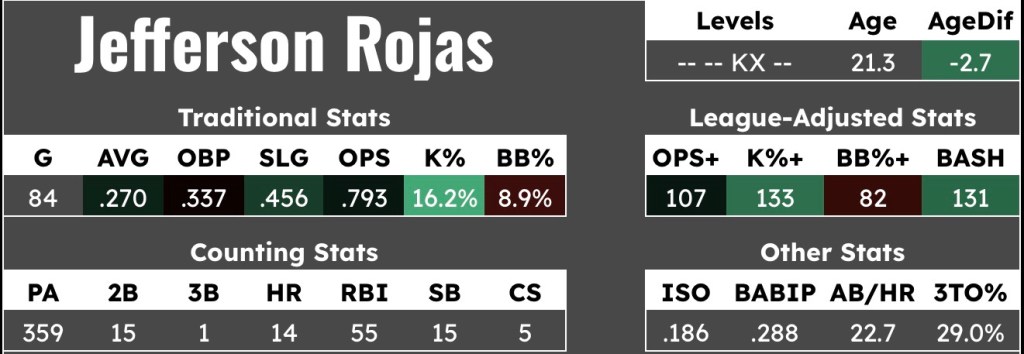
I’d like to introduce you to a complete hitter. What once started as a contact-oriented approach in the lower minors has expanded to include some of the best pull-side power in the organization. Oh, and he’s doing it at 21 years old in the upper minors. Now basically splitting time between shortstop and third base, I think Rojas can be a very good defender at third in the Majors. Most of the critiques of his shortstop defense revolve around his range and his throws when he has more than enough time, two things that become far less of a problem at the hot corner. I simply don’t know where he fits on Chicago’s roster, but we’re talking about a player I think could be a perennial 4-WAR player. Think peak Eduardo Escobar.
2. Josiah Hartshorn | OF/1B, High-A South Bend
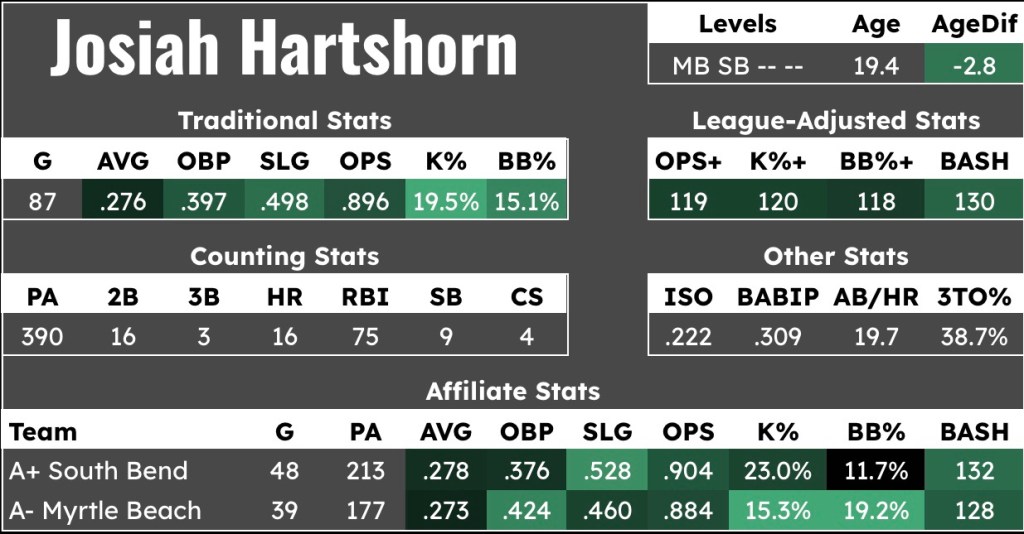
If you have Hartshorn ranked as your top prospect, you’ll hear no gripes from me. He has been a bonafide breakout this year, going from a guy we could dream on to a Top 50 prospect in baseball. It’s not a given that he gets called up to Knoxville later this year but if he does, Hartshorn will become the first Cubs high school draftee to reach Double-A in his first full professional season since Dyain Frazier in 1970. He’s amazing. I think both his plate approach and power are plus tools and the hit tool is strong as well. If he can wind up a RF instead of a 1B, it’s just icing on the cake. Hartshorn might be the only player on the Cubs farm capable of posting a wRC+ north of 130 at the big league level.
Tier 2
3. Owen Ayers | C, Triple-A Iowa
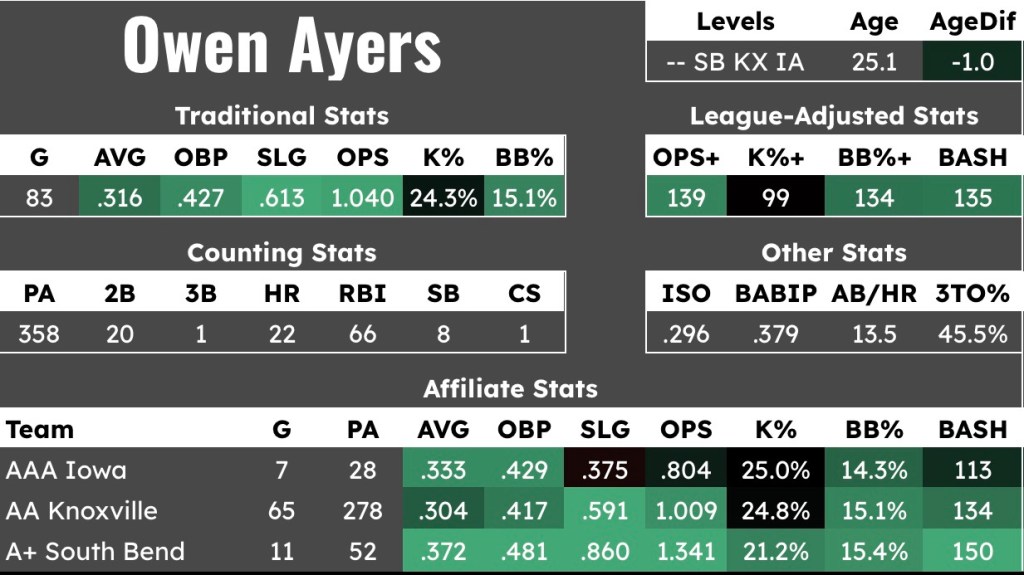
Over the years, there have been plenty of pop-up prospects. Guys who are a flash in the pan, give us crazy levels of excitement in short bursts of time, and ultimately fizzle out. They are often prospects that never truly give you the confidence to rank them top 10 in the system. Ayers feels different. The former 19th round pick shows legitimate power with plus exit velocities and has strong defensive abilities, led by a cannon strapped to his right shoulder. Now in Triple-A, I’m looking forward to seeing the Statcast-style metrics begin to normalize in a few weeks so we can have a better idea of his contact rates and, in turn, decide on what his future in Chicago might be. That might happen in 2026 but at the very least, he’s in competition for a role in the bigs next year since Carson Kelly hits free agency this offseason.
4. Jaxon Wiggins | RHP, Triple-A Iowa
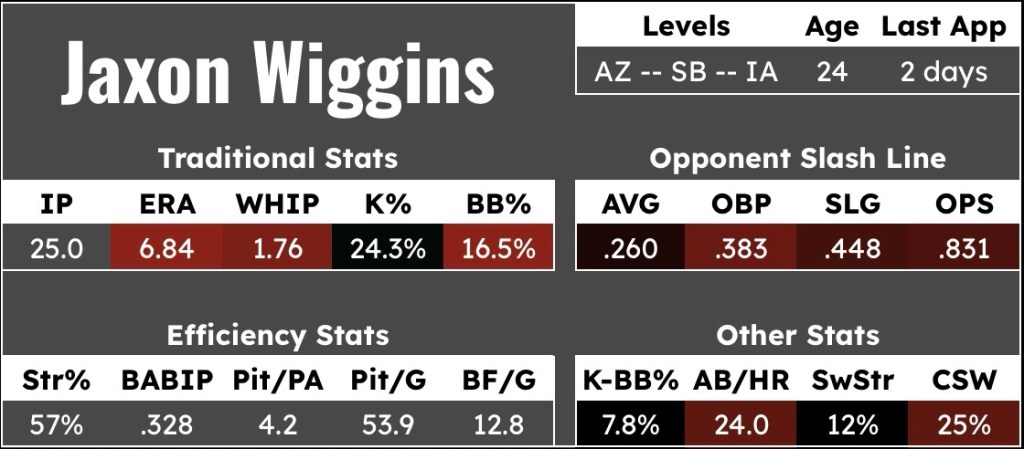
Hand up: I had Wiggins at #3 until minutes before I hit publish. I’m really grappling with whether his struggles since his return to the mound this year are due to rust or if it’s a serious concern. The fastball velo has been down a few ticks, which is notable given that the fastball is his bread and butter. His injury issues have only compounded this year and have led to me leaning reliver-profile more than I ever have to this point. With all that being said, along with the ugly stats above, it has still been just 25 poor innings for Wiggins this year, straddled between a long absence. He still has a fastball/slider/changeup combo that, when right, rivals any pitching prospect in all of baseball.
Tier 3
5. Ethan Conrad | OF, Single-A Myrtle Beach
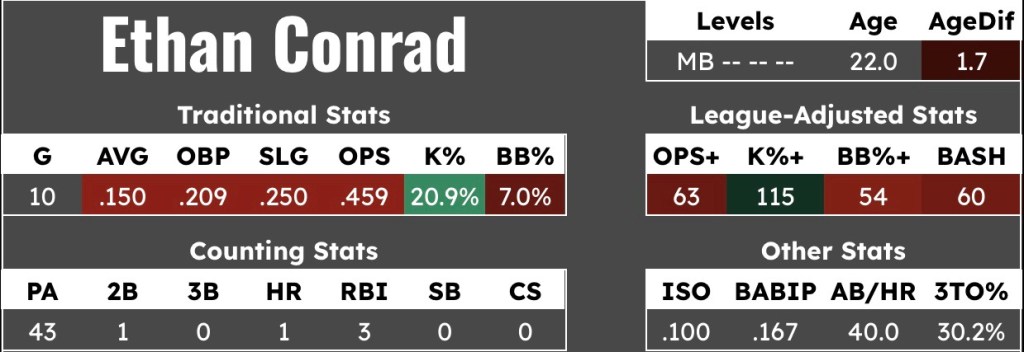
After missing most of the season to this point due to a back injury, Conrad recently returned and has shown off one of the prettier swings in the system. The results have been poor, but don’t really matter yet. I still think it’s more likely Conrad is the #1 prospect in the Cubs system this time next year than it is we see him ranked outside the top 8. More to come on this guy after the season concludes.
6. Kaleb Wing | RHP, Single-A Myrtle Beach
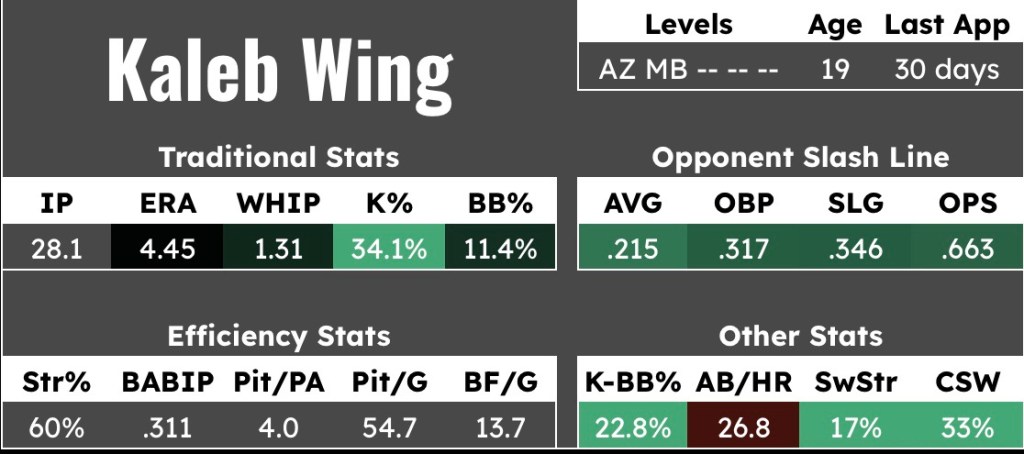
Don’t ask me about Kaleb Wing’s injury because I’d love to know the details just as bad as you. Until something leaks (maybe this offseason?) we’re stuck guessing and a guess isn’t gonna force me to slide him down my list. I can’t remember a time when I was this high on a high school arm with just 28 innings of pro experience. The stuff is disgusting — fastball, slider, and changeup all included. He’s still a ball of clay — but the clay is high-quality from a professional artist, not just Play-Doh my daughter forgot to seal up overnight.
7. Kane Kepley | OF, High-A South Bend
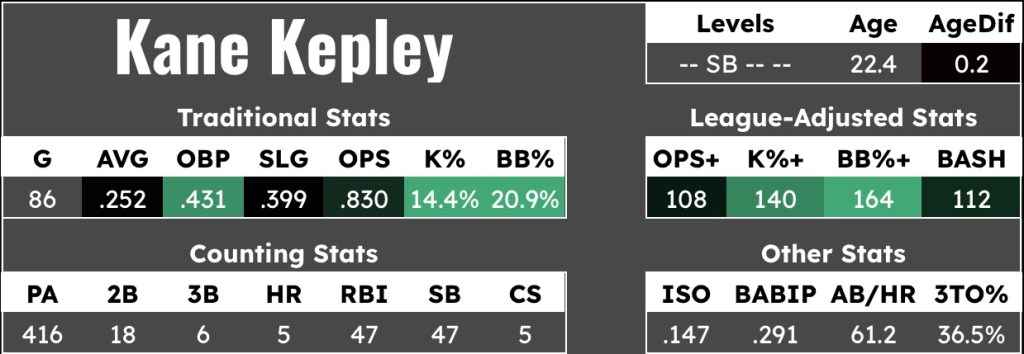
Someone could write a Kane Kepley prospect profile disguising as a novel with the amount of twists and turns it would contain. Instead, I’ll try to be efficient. The hit tool is very good, despite his lower batting average, but not as elite as I expected it to be coming into the year. The power is significantly better than what I expected. He’s a very strong guy despite his lack of height and I hoped power to the opposite field gap would come in a few seasons, not the very first of his pro career. His defense in center is strong but the speed and baserunning is legitimately outrageous. It’s the perfect combination of ability, aggressiveness, and smarts.
Tier 4
8. Mason McGwire | RHP, High-A South Bend
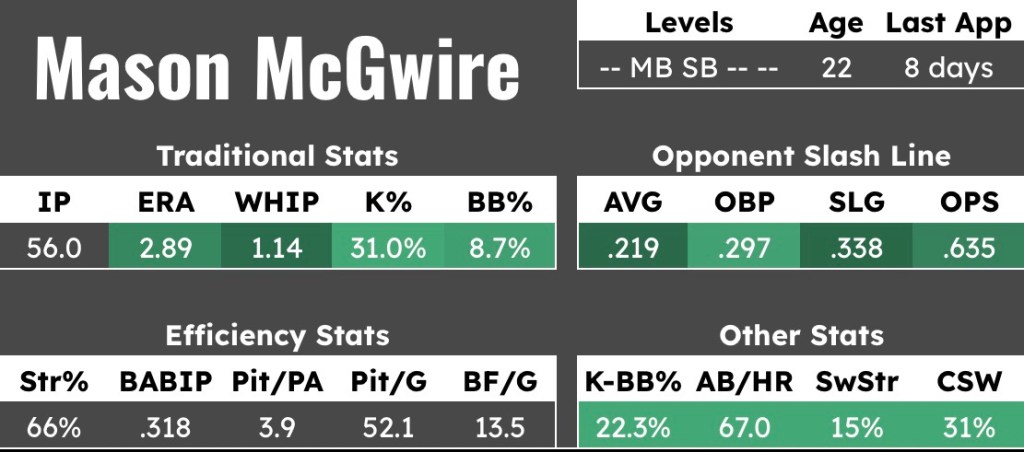
As a friend of mine likes to say, “Mason McGwire throws strikes.” Now, that’s a true statement as-is: McGwire is top 5 in the system in Strike%. But it feels different coming out of his hand, leading with a heavy fastball approach, where it just feels like every pitch he throws is a heater that lives above the belt, yet still touching the strike zone and always finding a whiff. Both the slider and changeup are fine offerings and have helped him to produce outrageously impressive results so far this year. He’s 1) the leader for Cubs MiLB Pitcher of the Year, and 2) the first of a grouping of pitchers that seem likely to be dealt from come the trade deadline next week (see the next three pitchers in my ranking).
9. Will Sanders | RHP, Triple-A Iowa
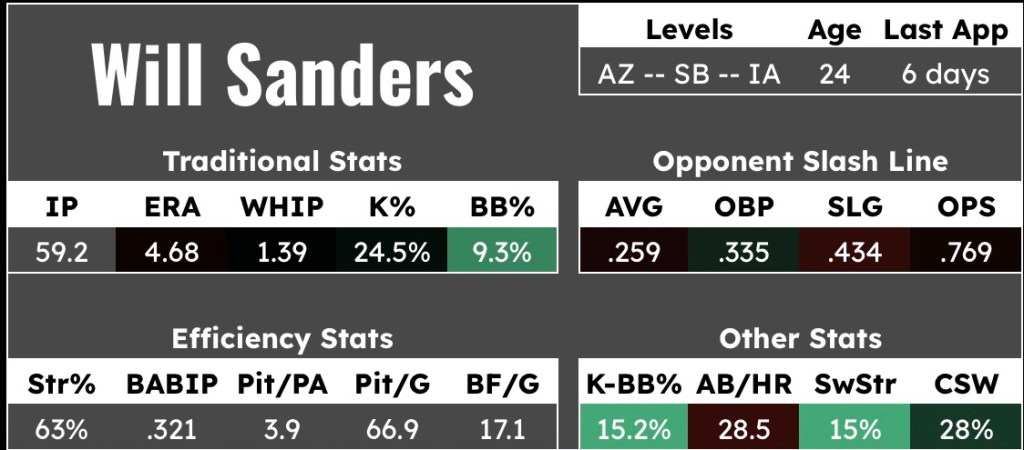
Will Sanders is Ben Brown. Okay, not really, but that sets the baseline here. We’re talking about a guy with one pitch I feel is extremely impressive (Sanders’ splitter vs. Brown’s knucklecurve), a fastball that’s less than impressive leading to a fair number of home runs, very solid control while still figuring out the command, and a moxie on the mound that makes him an entertaining watch. Because of the splitter, I feel good about falling back on a relief-only profile here. Because of his creativity on the mound, using multiple other offerings depending on what’s working on a given day or in a given inning, I think there’s legit back-end of the rotation potential here.
10. Pierce Coppola | LHP, High-A South Bend
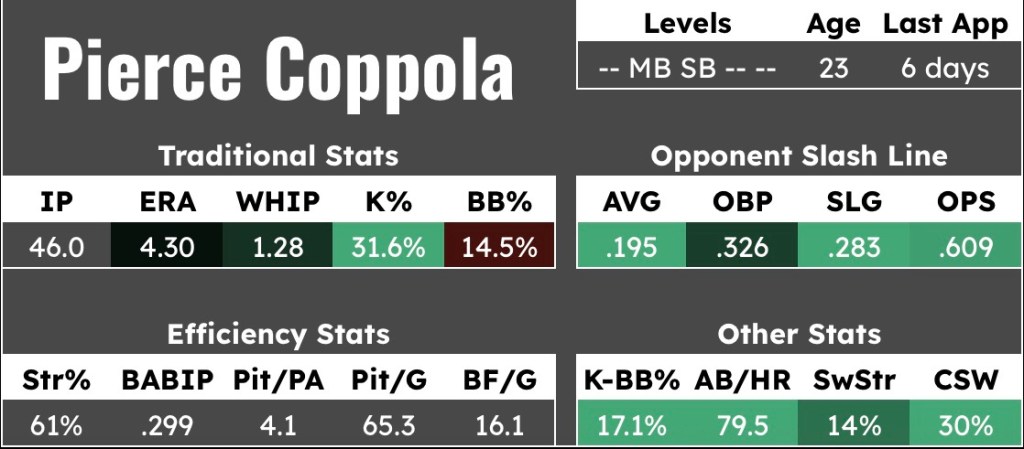
Pierce Coppola’s legs are longer than my entire body. He’s tall, lanky, comes at hitters with an unorthodox delivery, has more power to tap into, and still has made life extremly difficult on the opposition. Right now, he’s giving a variation of Luke Little but with disappointing velo readings in the low-90s. I think some serious offseason weight training could not only improve that velo into the mid-90s more consistently, but help make him stronger in the thighs and more athletic overall, assisting in a more consistent delivery… and lower walk totals. The most likely scenario here is reliever, but maybe more than anyone in the system not named Wiggins or Townsend, I can squint and see impact big league starter.
11. Jonathon Long | 1B, Triple-A Iowa
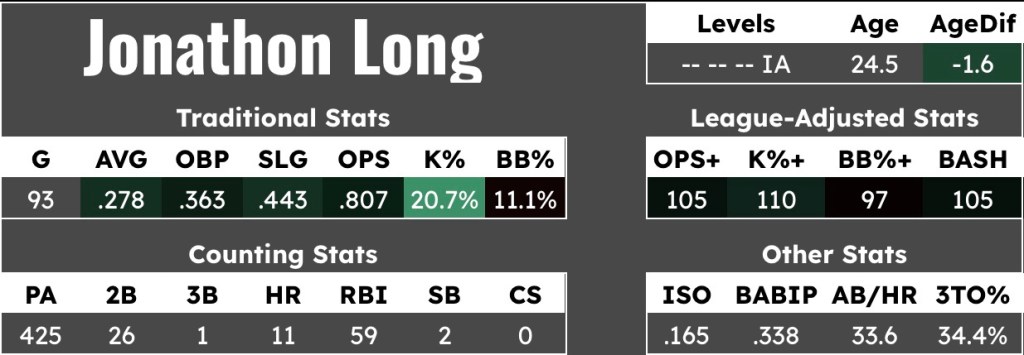
What a strange guy to rank right now, huh? Because of his relatively limited defensive profile at first base (there’s been more games in LF than I expected coming into the year), I’ve always said Long needs to absolutely rake. And without light-tower power, I become skeptical. Then he started off the year ice cold, constantly stuck in between — late on fastballs and early on offspeed. I do wonder, however, how much of that was due in part to the elbow injury he sustained in Spring Training. He’s really turned it on over the last couple months and I’m back to where I started: a poor man’s version of Moises Ballesteros.
12. Brooks Caple | RHP, Double-A Knoxville
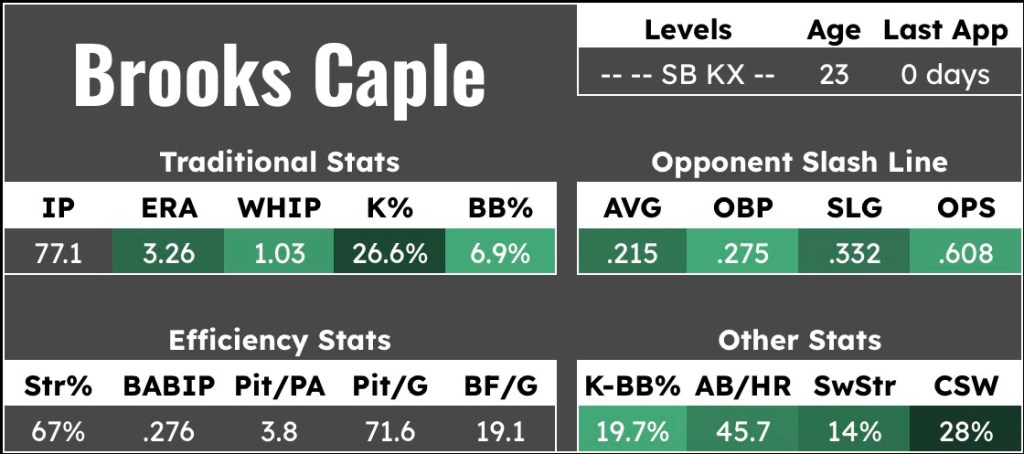
If Mason McGwire isn’t the Cubs MiLB Pitcher of the Year then Caple just might be. He’s been as much of a workhorse as the Cubs allow pitchers to be in the year 2026 and has dominated right-handed hitters with what appears to be a sinker/cutter mix. Lefties tend to hit him around a bit more, which isn’t uncommon but also is something that needs cleaned up. Much like last year’s first half breakout pitcher, Ryan Gallagher, I think it’s highly likely Caple is used in a trade package next week.
13. James Triantos | IF/OF, Triple-A Iowa
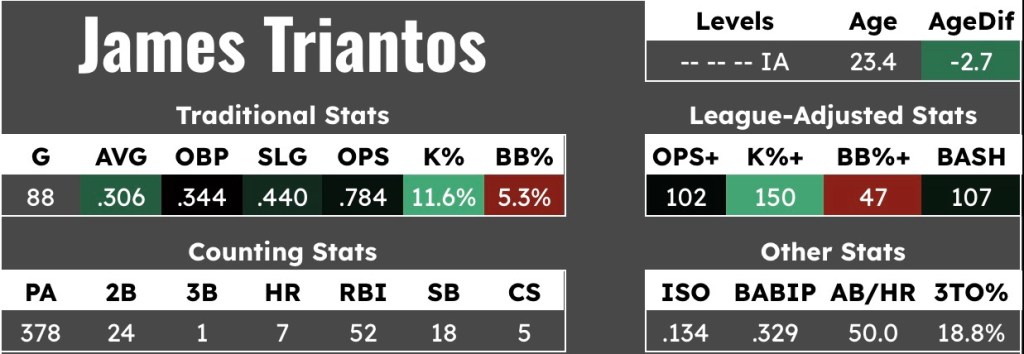
At this point in his career, it’s very obvious what James Triantos is as a player. The new Big Leaguer makes outrageous amounts of contact and chases pitches often which leads to weak contact, low strikeout totals, and a minuscule walk rate. He’s a very strong baserunner and can now chalk up 2B, 3B, and all three outfield spots on his resume defensively. He makes for a pretty damn good 26th man on a roster, serving in a role not all that dissimilar to someone like Vidal Brujan, a guy that’s logged MLB time in SIX different seasons at age-28.
14. Jace Beck | RHP, Triple-A Iowa
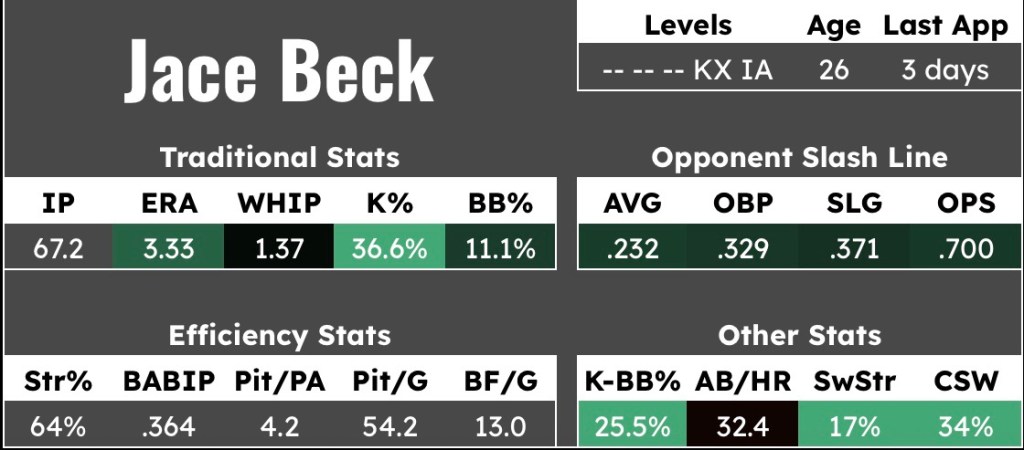
If there was one pitching prospect in the system that I trust with the ball on a big league mound tomorrow, it’s Jace Beck. That’s a wild statement to read following a first act of his career that saw Beck fail to escape High-A in the Mets organization over the course of six years. I broke the “news” of Beck’s signing on December 4th this past offseason without much fanfare (the replies were about what you’d expect). Now I could argue that the combination of the player’s hard work and organization’s identification of him is one of the best stories in the entire orgainzaiton.
Tier 5
15. Riley Martin | LHP, Chicago
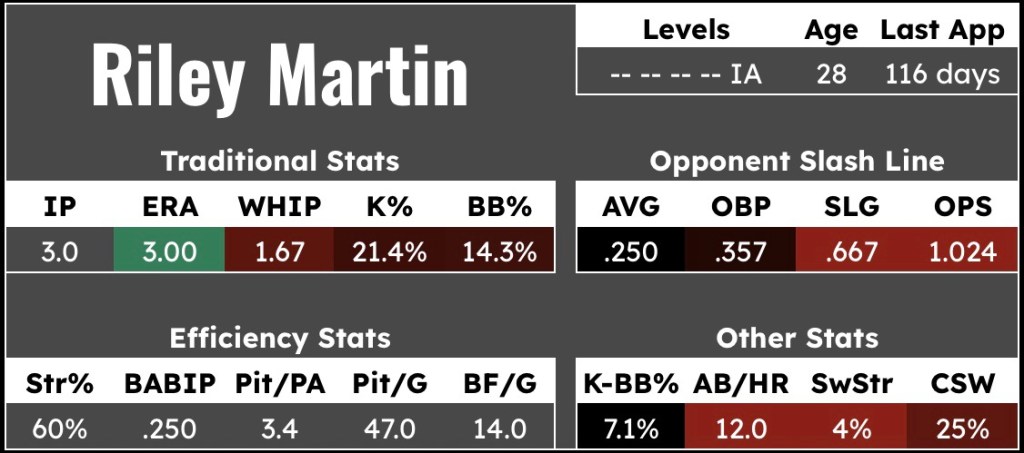
It seems kinda silly to inlcude Riley’s three Iowa innings in the graphic above, but oh well. The hope for him in his MLB call-up was that he would watch his walk rate fall precipitously like many pitchers with control issues have done in their boost up from Triple-A. Very quickly, partially because of his performance and partially because of the status of the Chicago bullpen, Martin became an impact reliever. I think he can continue that as soon as he returns from injury. We’re hoping this injury is just a blip on the radar for his success, and not something reminiscent of Brandon Hughes from a few years back.
16. Brandon Birdsell | RHP, Triple-A Iowa
NO STATS, RECOVERING FROM ELBOW SURGERY
I’m still holding firm on Birdie as a top 20 guy in the system. Part of that is due to the lack of impact pitching in the system and part is due to my strong belief in him when he’s healthy. When all is said and done, he’ll be back in full-force next year playing at 27 years old. That’s hardly a “traditional” prospect but he’ll also be in Triple-A ready to serve as MLB depth from the jump. I’ll be paying extra close attention to the fastball velo when he does return.
17. Grant Kipp | RHP, Triple-A Iowa
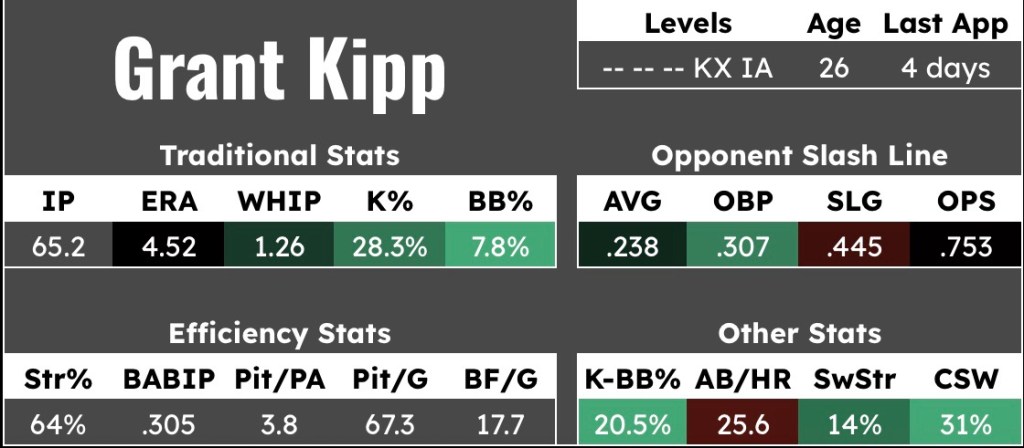
Finally in Triple-A, Kipp splits his offerings depending on who is at the plate. To righties, he’s predominantly sinker/slider. To lefties, it’s four-seam/curveball. I’ve come down a bit from the ladder I was atop proclaiming the good news about Kipp, mostly due to the fastballs that see more 90-92 than 93-95. But the dude still spins the breakers and gets results. He fits right in with this year’s draft class.
18. Angel Cepeda | SS, High-A South Bend
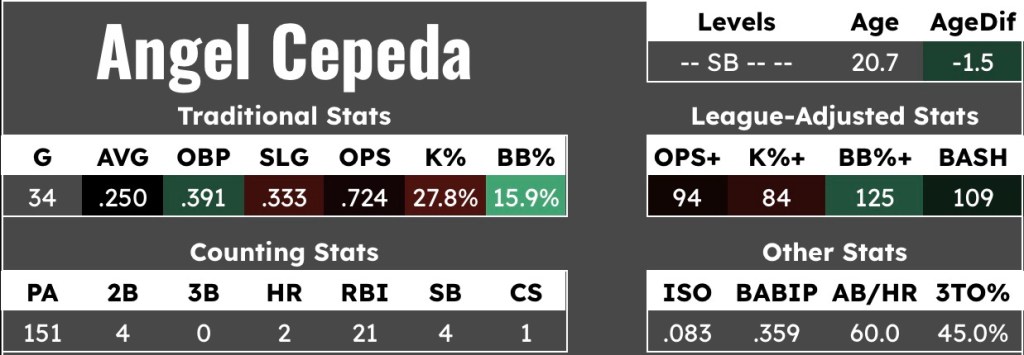
I think Cepeda deserves to be higher than this. I like his actions at short quite a bit and the approach is quite impressive at the plate despite swinging and missing at pitches in the zone too often. He’s experienced a strange season due to injury but he’s not too awful far off the pace set by our #1 guy Jefferson Rojas as young, toolsy shortstops. Gimme a strong end to the year and he’ll be sniffing top 10 status in no time.
19. BJ Murray Jr | 3B/1B, Triple-A Iowa
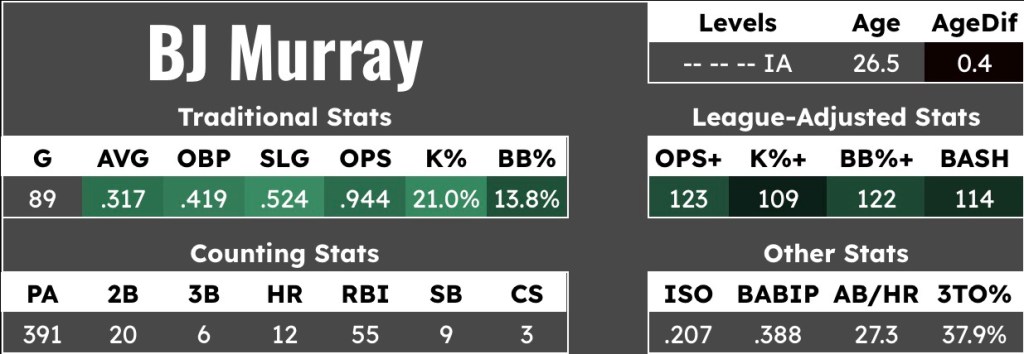
I’m not sure if we should consider this year as BJMJ building off his strong performance in Double-A last year or a rebound from his poor performance in Triple-A two years ago. Either way, he’s been really good. Bat-to-ball, approach, in-game power, defensive chops/flexibility, and even speed — it’s all solid and I think good enough to get semi-regular run on a non-playoff caliber MLB team. He’s a free agent after this year and while I think the Cubs are a coin flip from adding him to their 40-man roster, another team would gladly do the honors and will get a head start by trading for him at this deadline.
20. Brett Bateman | OF, Triple-A Iowa
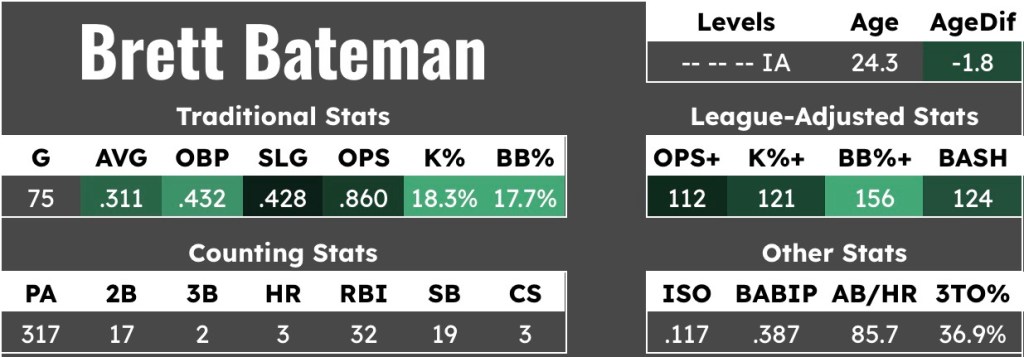
Listen, I’ll be the first to admit that I’ve been skeptical of Bateman The Prospect (while constantly pointing out that I’ve long been a huge fan of Bateman The Player). It’s super tough to project a guy with little power output and I expected the walk rate to drop significantly in the upper minors as pitchers challenge him more with pitches in the zone. Instead, he’s actually been one of the most productive hitters in the system this year. That’s in addition to his strong defense at all three outfield spots. Other orgs will be dying to include Bateman as the #2 piece in a trade package and I feel more confident in the 4th outfielder profile than I ever have.
21. Nick Dean | RHP, Double-A Knoxville
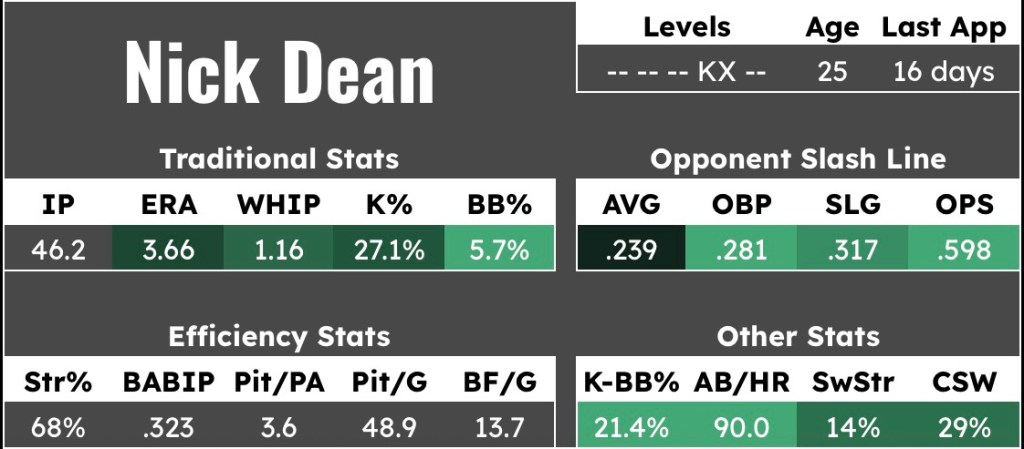
I’ll stand by Nick Dean’s side until he’s no longer in the system (and will still probably be there afterwards). It’s still a changeup-led pitch mix and the Cubs continue to tell me to listen to their actions as they hold him down in Double-A, even if I believe he has long deserved to be at the highest level of the minors. Last year, my main argument was that once you looked past the ERA and the AVG-against, the numbers under the hood were terrific. Now, my argument is that every last statistic is an absolute banger. He’s a damn good pitcher and I think he sees Major League innings at some point in his career.
22. Dominick Reid | RHP, Single-A Myrtle Beach
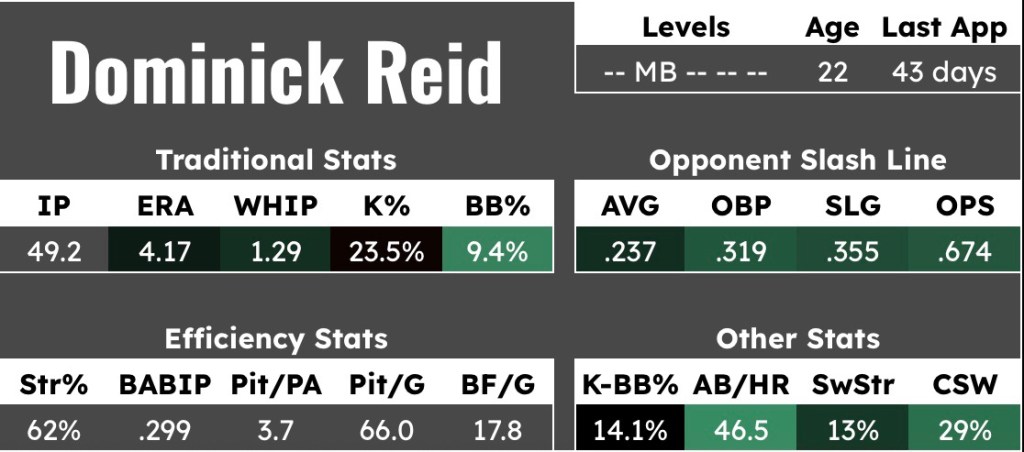
Reid mught actually be the toughest pitcher in the organization to evaluate. The highest drafted pitcher a year ago, the righty entered this season getting more love from me than other prospect writers and he began to prove me right this year in terms of the results he showed on the mound. Decent numbers across the board, but unfortunately it was thanks in large part to his very impressive changeup. I say “unfortunately” because he was doing it in Single-A, a level where changeups tend to make fools out of a lot of teenagers. He left his last start due to injury about a month and a half ago and was very recently transferred to the 60-day IL, which ultimately slid him down a few more slots in these rankings.
Tier 6
23. Carter Trice | OF, Double-A Knoxville
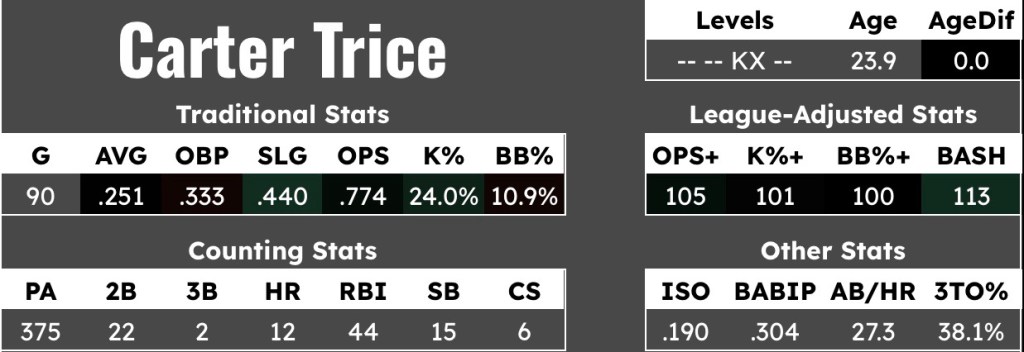
The improvements we’ve seen from Trice year-over-year have been impressive and this year we’ve seen him lower his strikeout rate to a more acceptable level. No one tool sticks out in a huge way but the power has been his calling card up to this point and his defense in center looks better as he continues to gain experience out there.
24. Ty Southisene | 2B/SS, High-A South Bend
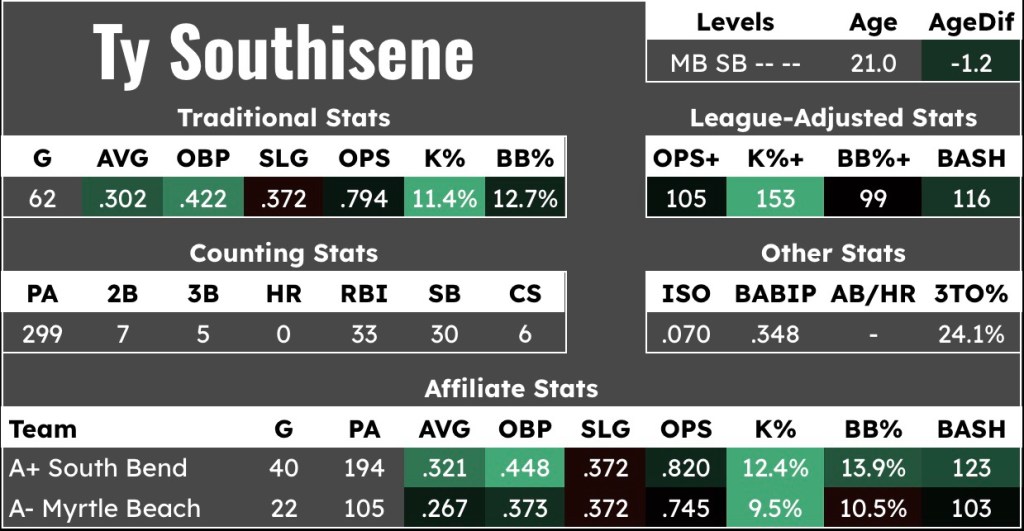
While I still think his ultimate defensive home is at second base, this has been a huge year where Ty has proven his plus skills at the keystone translate just fine to short (not unlike Nico Hoerner’s situation in Chicago). While the bat-to-ball continues to be elite as he leads the system in K%, I still struggle mightily to find the offensive value as he climbs the ladder. The pop is unlikely to ever come around and he doesn’t walk at the impressive rates that some other contact-oriented hitters in the system do (BB% is squarely league average).
25. Kevin Valdez | RHP, Double-A Knoxville
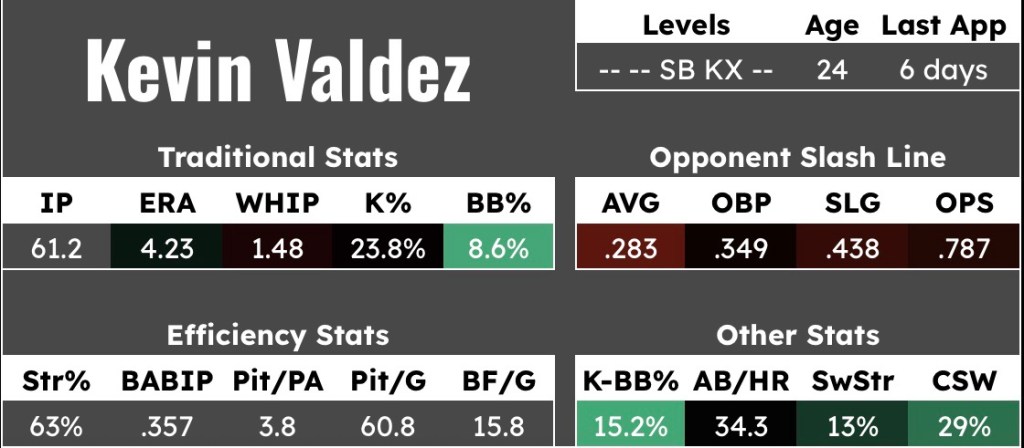
While I’m including the season-long numbers above, it’s really his last 2.5 months that have stood out in a way that’s plopped Valdez squarely on the radar. Until he made his Double-A debut last week, his last ten outings in South Bend read: 2.35 ERA, 31% strikeouts, 8% walks. He’s a Kitchen Sink Guy with some serious movement on his pitches. This absolutely could be me reading into a small sample size too much and avoiding what we saw to this point in his career. But in case it’s not… here he is at 25.
26. Ethan Flanagan | LHP, High-A South Bend
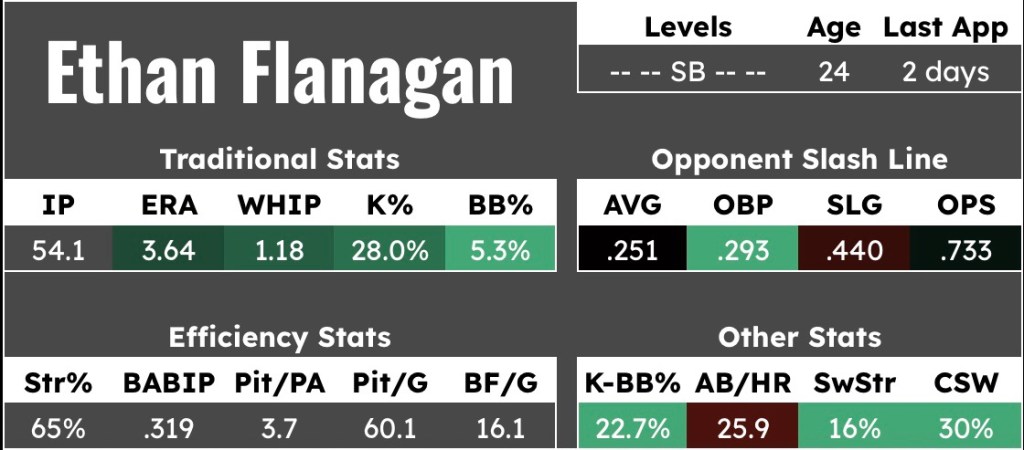
I tried to find a way to sneak Flanagan up these rankings a bit but will stick with him here instead. He reminds me a bit of Will Sanders but from the left side, both in terms of his mound presence (size and swagger) and overall results. Unlike Sanders, he doesn’t have a plus secondary to offer but seems comfortable with any of his offerings on any given night. A couple more ticks on the heater would do absolute wonders.
27. Jose Escobar | LF, High-A South Bend
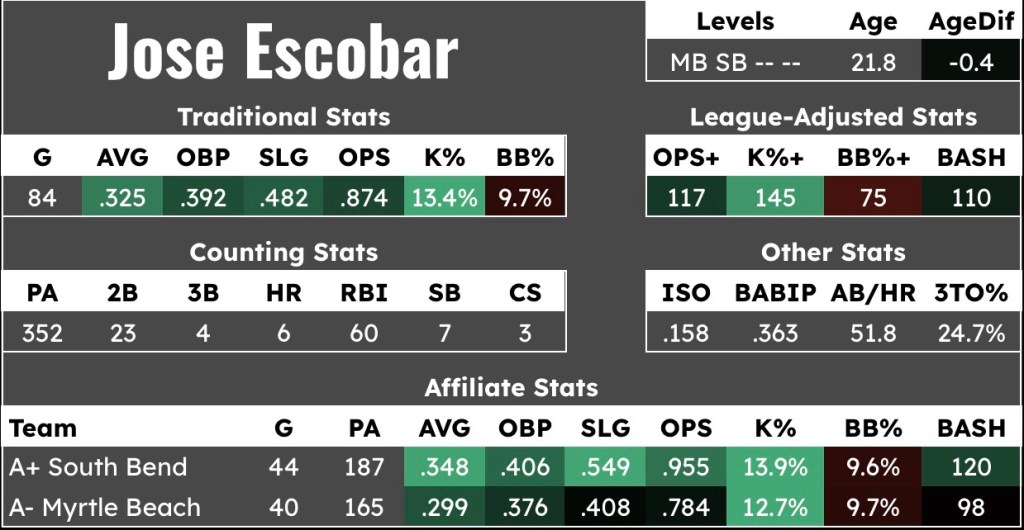
It’s felt like I’ve had Escobar hovering around the cut-off point of my prospect lists for the past several years. All it took for the Cubs to finally promote him to South Bend was an absolute refusal to strike out. I still think there’s a bit more power production in there, but he’s a good answer to the question: what would Brett Bateman/Kane Kepley look like without the same levels of baserunning and defensive value?
28. Logan Poteet | C, High-A South Bend
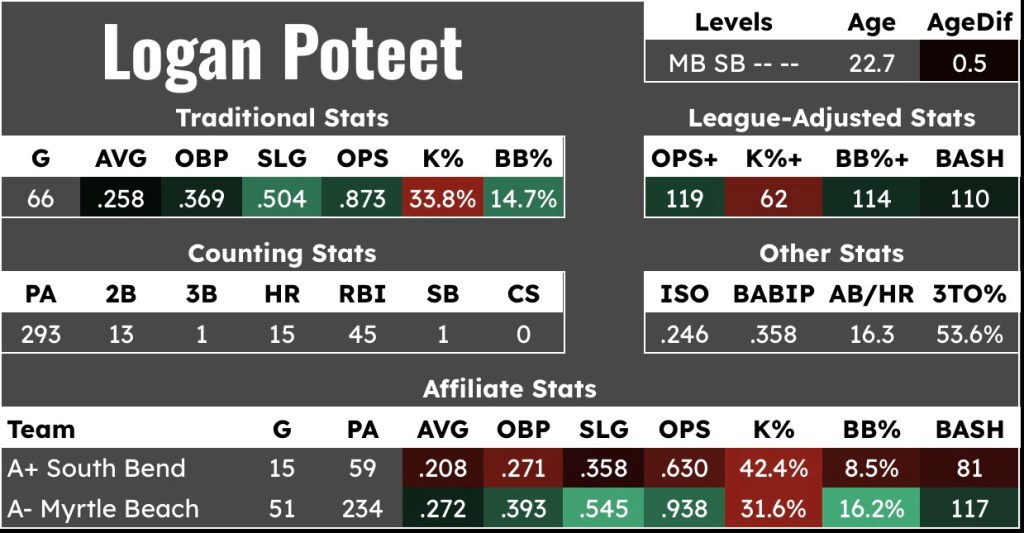
Having a prospect ranked 28th in the system with one legit tool that makes you say wow isn’t typical but Poteet’s power does that for me. He showcased some mammoth homers during his time in Myrtle Beach, a park where it’s not easy to show off pop (even with the new fences drawn in). Strikeout rates north of 30% ain’t gonna cut it, but this is still just his first full season. Ultimately, both the power and strikeouts will deviate toward average over the next couple years.
29. Alex Ramirez | OF, Double-A Knoxville
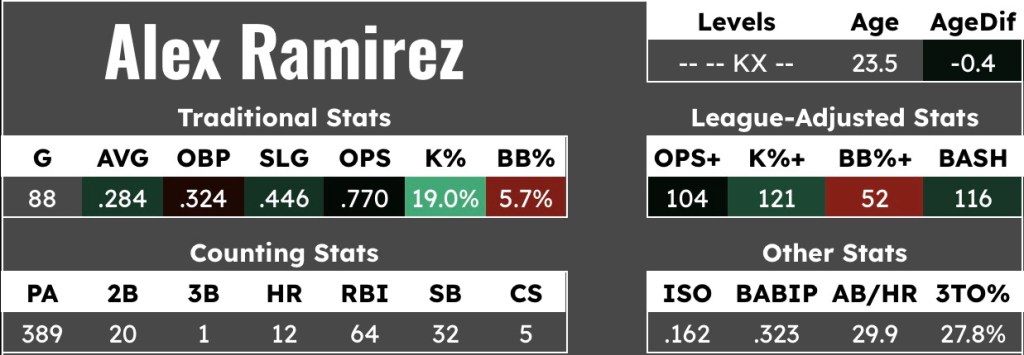
Fifteen slots above here, you’ll find a similar story to Ramirez in Jace Beck. Both players spent several years in the Mets system without much to speak of in terms of results. And actually, Ramirez had more “prospect” juice than Beck, as he was once a Top 100 prospect in baseball. The difference is that wild-and-random breakouts are more frequent in pitchers than hitters. Still, it’s hard to ignore what we’ve seen this year in the power/speed combo from the still-23-year-old.
30. Yoendris Gonzalez | RHP, Single-A Myrtle Beach
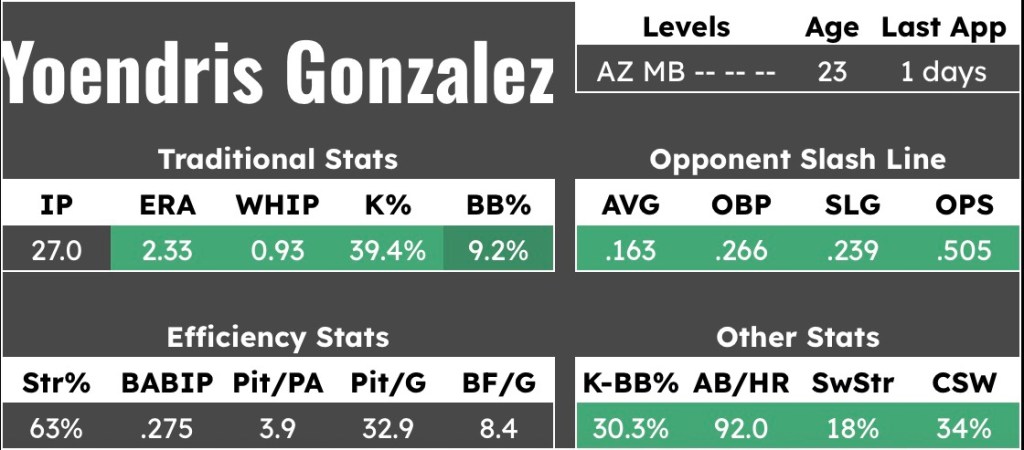
In a list that features mostly names you’re familiar with (partially due to my eligibility requirements), this might be the guy that’s new to you. I’ll admit I’m banking on a velo jump from a guy that doesn’t look like a velo jump is likely. He’s already strong without much height, but the breaking ball is a no-joke whiff pitch. It’s led to ridiculously elevated strikeout and whiff rates, albeit at 23 years old in Single-A.
Honorable Mentions (alphabetical)
Ariel Armas | C, Double-A Knoxville
Ivan Cespedes | C, Single-A Myrtle Beach
Michael Carico | 1B, High-A South Bend
Fernando Cruz | IF, Single-A Myrtle Beach
Andy Garriola | OF, Double-A Knoxville
Matt Halbach | 3B/1B, High-A South Bend
Luis Martinez-Gomez | RHP, Double-A Knoxville
Dawson Netz | RHP, Double-A Knoxville
Christian Olivo | IF/OF, High-A South Bend
Kenyi Perez | RHP, Double-A Knoxville
Marino Santy | LHP, Double-A Knoxville
Tyler Schlaffer | RHP, Double-A Knoxville
Kade Snell | OF, High-A South Bend
For those of you that have stuck around to the end, I’ll throw you a bone for where I would generally rank the newly drafted players if you pressed me on it. I’ll admit that draft picks are FAR easier for me to do this than IFA signings — more film in college than in the Dominican or Venezuela does the trick, especially for college guys. So here’s the range where six draftees belong:
Cade Townsend | RHP, 1st rd: Between #3 & #6
Caden Sorrell | OF, 2nd rd: Between #4 & # 8
Myles Bailey | 1B, Comp rd: Between #6 & #11
Dylan Blomker | RHP, 5th rd: Between #8 & #15
Carson Jasa | RHP, 3rd rd: Between #15 & #29


[…] America’s Hot Sheet. That did not happen this week as Greg Huss of the Cubs on Deck podcast dropped his top Cubs prospect list. As many of you know, Greg does not include any prospects that have not played at a full season […]
LikeLike